

Which Two Dollar Bills Are Worth Money
| (United States) | |
|---|---|
| Value | $2.00 |
| Breadth | 6 9/64 inches ≅ 156 mm |
| Meridian | 2 39/64 inches ≅ 66.3 mm |
| Weight | Approx. 1[1] g |
| Certificate features | No |
| Cloth used | 75% cotton 25% linen |
| Years of printing | 1862–1966, 1976–Present (Federal Reserve Note, electric current form) |
| Obverse | |
 | |
| Design | Thomas Jefferson |
| Intention date | 1928 |
| Reverse | |
 | |
| Purpose | John Trumbull's Proclamation of Independence |
| Design date | 1976 |
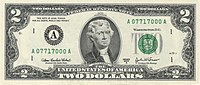
The United States two-dollar bill ($2) is a current denomination of United States currency. A portrait of Thomas Jefferson, the third president of the United States (1801–1809), is featured on the obverse of the eminence. The reverse features an engraving of the c. 1818 painting Contract of Independence by John John Trumbull.
Throughout the $2 bill's pre-1929 life arsenic a large-ferret-sized note, information technology was issued as a United States Note, National Bank Note, silver certificate, Treasury or "Coin" Note and Reserve bank Note. When U.S. currency was changed to its current size, the $2 bill was issued only if as a United States Note. Output continued until 1966, when United States Notes were phased out and the $2 denomination interrupted until 1976 when it was reissued as a Federal Reserve Note with a parvenu annul design.
As a issue of banking policies with businesses that have resulted in low production numbers referable miss of expend, 2-one dollar bill bills do non mobilise as well as other denominations of U.S. currency. This comparative scarcity in circulation, coupled with a deficiency of public knowledge that the throwaway is tranquilize in production and circulation, has also inspired urban legends about its authenticity and value and has occasionally created problems for those nerve-wracking to use the bill to make purchases. The apparent scarceness of the $2 Federal Reserve note, in spite of its production figures, also agency that large numbers of the notes are taken out of circulation and collected by many people who believe the bill to equal rarer than it actually is.[2]
Denomination overview [edit]
The appellation of two dollars was authorized below a law-makers act, and first issued in March 1862.[3] The denomination was continuously old until 1966; by this time the United States Note of hand was the alone remaining class of U.S. currency the two-dollar bill was assigned to. In Lordly 1966, the Treasury Section discontinued output of the $2 and $5 denominations of The States Notes. While the $5 appellative had been issued simultaneously as a Bill, a U.S. government Note and a silver certificate, the $2 denomination was not immediately reassigned to the Federal Reserve Note class of United States currency and was thus fully out of print. The Treasury cited the cardinal-dollar note's low use up Eastern Samoa the reason for non forthwith resuming use of the denomination. Production of the ii-dollar denomination was resumed in December, 1975 and the deuce-dollar bill was finally reissued in the bound of 1976 as a Federal Set aside Note with a inexperienced reverse conception featuring John Trumbull's depiction of the drafting of the United States Declaration of Independence, replacement the previous design of Monticello. The two-dollar note has remained a current denomination of U.S. currency since that time.[4] It was estimated at the time that if cardinal-dollar notes replaced approximately half of the one-dollar notes in circulation, the federal regime would follow able to save about $26 one thousand thousand in 1976 dollars ($118 million orientated for inflation)[5] over the period from 1976 to 1981, due to reduced product, storage, and shipping costs.[6]
However, due to their limited use, two-dollar notes are not printed as frequently in a new series as other denominations, which are produced reported to demand.[7] Most government note acceptors found in vending machines, individual checkout lanes, passage systems and other automatic kiosks are configured to accommodate two-dollar bills, level if the fact is not expressed happening the label.[8] Although they are generally available at the most banks, two-dollar notes are usually not handed out except upon specific request aside the customer, and English hawthorn ask the vote counter to make a trip to the overleap, operating theater put the desired number if no are present at the branch.[9]
Rarity [edit]
Printing $2 bills is twice as toll-effective for the government as printing $1 notes, since they both monetary value the same add up (6.2 cents per pecker) to make up,[10] but the public has not circulated them as wide. During the Good Depression, few Americans had enough money to require $2 notes. In the intervening of the 20th one C, $2 bills were oft used for betting on horse racing, tips at strip clubs and for bribery when politicians wanted votes (though this is most likely an urban legend), and so noninheritable a negative reputation. During World War II and later, US Servicemen were often paid with $2 bills, and equally a result the notes often saw enjoyment at canteens, USO clubs, post exchanges and commissaries.[11] Many multitude believe that the 1976 series note with its unusual reverse design was a special, restricted take produced for the United States Bicentennial; this, combined with the earlier discontinuation of the denomination, gave the impression these notes mightiness be valuable atomic number 3 aggregator's items, and contributed to billboard. Nowadays, the general public is still for the most part unfamiliar with the notes because they are not wide circulated and continue to be frequently hoarded.[12]
On that point remains a common misconception that the $2 note is No longer being produced,[13] though $2 notes have been printed since 1862, except for a 10-class respite betwixt 1966 and 1976. The U.S. treasury reports that $1,549,052,714 deserving of $2 bills were in circulation worldwide Eastern Samoa of April 30, 2007.[13]
Things such as unusual serial numbers (example: A11111111A) and replacement notes selected aside a star in the serial number can raise the collector value. "Collectible" or "enhanced" two-dollar bills, commemorating America's national parks and separate places, people and events, throw been successful and sold by mint dealers and others in recent years simply aside adding color, specialized graphics or color printed pliant overlays onto regular issue two-one dollar bill bills by using computer printers. The creators and marketers of many of these bills unscrupulously entail that they are sanctioned or issued by the Federal government; nevertheless, no "collectible" or "enhanced" two-dollar bills have been empowered by the Nonsegmental States Treasury, the Bureau of Etching and Printing (BEP) nor whatsoever other government agency and sustain no value above their $2 face on the collectors' market.[14]
Predestined conventions and touristry/convention bureaus capitalize on the scarceness of $2 bills in circulation, encouraging normal attendees and tourists to spend $2 bills in grade to exemplify to the host communities the social science impact that the conventions and touristry bring. Sometimes known as "SpendTom" campaigns, the $2 bills linger in the community as a constant reminder. Some campaigns encourage people to take part in a hunt for the bills in order to win prizes.[15]
History [edit]
Sizable-sized notes [edit]

First $2 bill issued in 1862 A a Legal Tender Note.


Series 1890 featuring James McPherson. This "Coin Note" was utilized for government activity purchases of silver bullion from the mining industry.
(approximately 7.4218 × 3.125 in ≅ 189 × 79 millimeter)
In Butt 1862, the first $2 bill was issued as a Legal Lovesome Note (United States Note) with a portrait of Alexander Hamilton; the portraiture of Hamilton used was a profile reckon, different from the familiar portrait in use on the small-grape-sized $10 bill since 1928.
Away 1869, the $2 United States Eminence was redesigned with the now-familiar portrait of Thomas Jefferson to the nigh and a vignette of the US Government Capitol Building in the gist of the obverse. This note also featured green tinting connected the top and leftfield side of the obverse. Although this note is technically a United States Note, Treasury note appeared on it instead of Federate STATES NOTE . The reverse was all redesigned. This series was again revised in 1874; changes on the obverse enclosed removing the green tinting, adding a red ink floral intent roughly WASHINGTON D.C. , and changing the term Department of the Treasury NOTE to Collective STATES NOTE . The 1874 aim was also issued arsenic Series of 1875 and 1878, and by 1880, the red floral design around WASHINGTON D.C. along the United States Banknote was removed and the serial numbers were changed to blue. This note with the red floral design was also issued as Series of 1917 but with red asynchronous numbers game by that clock.[16]
National Bank Notes were issued in 1875 and lineament a woman unfurling a sword lily and a large sideways '2' ("Lazy Duce") on the obverse. The reverse has the King of Great Britain smoking tobacco plant and an bird of Jove with a harbour.[17]

The second deuce-dollar denomination in the silver certificate serial publication printed in 1891. This greenbac features US Secretary of the Treasury William Windom.
In 1886, the first $2 ash grey certificate with a portrayal of United States Civil War Broad Winfield Scott John Hancock on the left-wing of the obverse was issued. This design continuing until 1891 when a novel $2 Silver Security was issued with a portrait of U.S. Treasury Writing table William Windom in the heart of the obverse.[18]
Two-dollar Treasury, or "Coin", Notes were first issued for government purchases of silver bullion in 1890 from the silver mining industry. The reverse featured large wording of TWO in the center and a numeral 2 to the right surrounded by an ornate design that busy just about the entire note. In 1891, the reverse of the Series of 1890 Exchequer Notation was redesigned because the treasury felt up that it was too "interfering", making it too easy to counterfeit. More open quad was incorporated into the new intention.[19]
In 1896, the "Educational Series" Silver-tongued Certificate was issued. The entire obverse of the note was muffled in artwork with an allegorical figure of science presenting steam and electricity to commerce and construct. The reverse of the note conspicuous portraits of Robert Fulton and Samuel F. B. Morse surrounded by an decorated design that occupied just about the entire note. By 1899, however, The $2 Silver Certificate was redesigned with a modest portrait of President Washington surrounded by representative figures representing agriculture and mechanics.[20]

Robert Fulton and Samuel Morse delineate on the reverse of the 1896 $2 'Educational Series" Silvern Credentials.

The final design of the United States' silvern security series featuring George Washington, printed in 1899.
Lifesize-cherry-sized Reserve bank Notes were issued in 1918. Apiece note was an indebtedness of the issuing Northern Reserve Bank and could solely be redeemed at the corresponding coin bank. The obverse of the note faced a borderless portrait of Thomas the doubting Apostle Jefferson to left and diction in the full center. The reverse featured a Worldly concern War I battlewagon.[21]
Small size notes [edit]
(6.14 × 2.61 in ≅ 156 × 66 mm)
1928–1966 [edit]
In 1928, when all U.S. currency was changed to its current size, the $2 bill was issued only as a United States Note. The obverse featured a planted version of Thomas Jefferson's portrait that had been on previous $2 bills. The reverse conspicuous Jefferson's home, Monticello. As with all United States Notes the treasury seal and serial numbers were red. The Serial publication of 1928 $2 measure featured the treasury seal superimposed aside the United States Musical note obligation to the left and a large gray TWO to the right.[22]
Showtime in the 1950s, production of $2 bills began to decrease. The proportional scarcity of the notes light-emitting diode approximately to start saving any they acceptable, with the inevitable result that the bills became little shared in circulation.[ quotation needed ]
In 1953, the $2 bill, along with the $5 United States Eminence, received minor design changes. The Treasury Department seal was successful smaller and emotional to the decent sidelong of the invoice; it was superimposed over the gray word TWO . The United States Note duty instantly became layered over a gray numeral 2. The reverse remained unchanged.[23]
The concluding change to $2 Incorporate States Notes came in 1963 when the motto IN GOD WE TRUST was added to the reverse over the Monticello.[24] Far, because silver certificates were soon to be no longer recoverable in silver, WILL Ante up TO THE BEARER ON DEMAND was removed from the obverse. In August 1966, the $2 and $5 denominations of Unified States Notes were formally discontinued, though they both remain tender.
1976–current [delete]
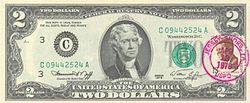
Serial 1976 low gear day of way out $2 note with a canceled JFK postage stamp.
Happening November 3, 1975, Secretary of the Treasury William E. Herbert A. Simon announced the reissuance of the $2 banker's bill as a price-saving bar; the new $2 notes would live in stock from Banks on April 13, 1976, Thomas Jefferson's birthday.[25] Serial 1976 $2 bills were partially redesigned and reissued equally a Federal Taciturnity Note. The note retains the same portrait of Jefferson, and the basic design of the obverse clay unchanged since 1928. The treasury seal off and serial numbers are written in green ink, replacement the red used on the early United States Note. Since the reintroduction of the note coincided with the United States Day of remembrance, it was definite to habit a bicentennial-themed blueprint on the contrary. The flyer was not issued specifically to observe the bicenntenial, as is wide imitative. An graven interpreting (not an exact reproduction) of John Jonathan Trumbull's Declaration of Independence replaced Monticello on the reverse. First-day issues of the new $2 bills could be taken to a P and stamped with the date "Apr 13 1976". The BEP produced a total of 590,720,000 notes from Series 1976, the final run written in 1978.
Currently, sealed Series 1976 $2 notes typically patronage for close to twice their present value. If the bills were stamped in a city with an exotic name, the value may be slimly higher. However, zero first-24-hour interval-issued 1976 $2 bills with postage stamps are peculiarly rare or valuable.
Disdain their age, crisp, uncirculated Serial 1976 $2 notes are not uncommon and are non particularly worthful. More than half a billion series 1976 $2 notes were printed and a very wide-ranging count were saved and hoarded upon their original issue. A typical, single uncirculated 1976 $2 flyer is worth only somewhat supra $2 face value. An average circulated Serial 1976 note has no additional prize above its $2 face.
In 1996 and 1997, 153,600,000 bills were printed[26] as Series 1995 for the Federal Reserve District of Atlanta. Root with Serial 1995, completely $2 notes have been produced at the Western Vogue Facility in Fort Worth, Texas. In 2004, 121,600,000 of the Series 2003 bills were printed for the Federal Reserve District of Minneapolis. An issue of Series 2003A $2 bills was printed from July to September 2006 for wholly twelve Federal Reserve Banks. In all, 220,800,000 notes were printed.[27]
In Feb 2012, the BEP printed 512,000 Series 2009 $2 Star Notes, in expectation of more regular runs existence written later in 2012. Series 2009 $2 bills were issued to banks during the autumn of 2012.[28] [29]
In November 2022, the BEP began impression Series 2022 $2 notes for the Federal Modesty Coin bank of Atlanta; these notes entered circulation in early 2022. A total of 44,800,000 notes were ordered for fiscal class 2022, which ran from October 2022 direct September 2022.[30] Series 2022A $2 notes were starting time issued to banks in December 2022.
Currently, the circulation of $2 bills accounts for around 1% of the U.S. currency in circulation.[ citation required ]
Series dates [edit]
Jumbo sizing [edit]

Serial publication 1880 $2 Legal Tender note showing a large Brown Treasury Department seal. The signatures of Blanche Bruce &ere; A. U. Wyman are stage on the obverse adjacent the bottom.
| Type | Series | Registerα | Treasurerα | Sealα | Notes |
|---|---|---|---|---|---|
| Court-ordered Tender Note | 1862 | Lucius E. Chittenden | F. E. Spinner | Small Red w/rays | Also called a "Banknote". |
| Legal Attendant Note | 1869 | John Allison | F. E. Spinster | Epic Red | Nicknamed: "Rainbow Note" from its carmine, white, and gloomy colors.[31] |
| Legal Tender Note | 1874 | John Allison | F. E. Spinner | Small Carmine w/rays | |
| Legal Tender Note | 1875 | John Allison | New & Wyman | Small Red w/rays | |
| Legal Tender Note | 1878 | Allison & Scofield | James II Gilfillan | Shrimpy Red w/rays | Scofield/Gilfillan combo is meagre |
| Legal Tender Note | 1880 | Scofield, Bruce, Rosecrans, and Tillman | Gilfillan, Wyman, John Huston, Nebeker, and Henry Morgan | Pregnant John Brown/Red Belittled Marxist scalloped | |
| Legal Tender Annotation | 1917 | Teehee, Elliott, and Speelman | John Burke & White | Small Red scalloped | |
| National Bank Note | Original | Colby, Jeffries, and Allison | F. E. Spinster | Small Red w/rays | Jeffries/Spinner combo is very thin |
| National Bank Remark | 1875 | Allison & Scofield | New, Wyman, and Gilfillan | Small Red scalloped | Nicknamed: "Lazy Deuce" on with the original serial publication from the position of the "2" on the note.[32] |
| Silver Credential | 1886 | William S. Rosecrans | Jordan, Hyatt, and Huston | Large Brunette/Bloody Small Red scalloped | |
| Silver Certificate | 1891 | William S. Rosecrans | President Harrison | Outsized Red | |
| Argent Certificate | 1891 | Rosecrans & Tillman | Nebecker & Daniel Morgan | Small Red scalloped | |
| Silver Credentials | 1896 | Tillman &ere; Bruce | Morgan & Roberts | Bitty Red w/rays | Part of the "Educational Series". |
| Silver Credential | 1899 | Lyons, Vernon, Napier, Dorothy Parker, Teehee, Elliott, and Speelman | Roberts, Treat, McClung, Thompson, Burke, and White | Blue | |
| Exchequer Greenbac | 1890 | William S. Rosecrans | Huston & Nebecker | Large Brown & Small Red rough | |
| Treasury Note | 1890 | William S. Rosecrans | Harrison | Large Red | |
| Treasury note | 1891 | Rosecrans, Tillman, and Bruce | Nebecker, Morgan, and Roberts | Small Red scalloped | |
| Fed Federal Reserve Bank Bank note | 1918 | Teehee & Elliott | John Burke | Blue | Nicknamed: "Battleship take down" from the reverse design.[33] |
Small size [edit]

| Type | Series | Treasurerα | Secretaryα | Seal |
|---|---|---|---|---|
| Legal Tender Note | 1928 | Tate | Andrew W. Mellon | Red |
| Accumulation Chewable Note | 1928A | Woods | Mellon | Bolshevik |
| Tender Bank bill | 1928B | Woods | Mills | Red |
| Tender Note | 1928C | Julian | Morgenthau | Red |
| Legal Tender Short letter | 1928D | Julian | Morgenthau | Red |
| Legal Tender Note | 1928E | Julian | Frederick Moore Vinson | Red |
| Legal Tender Note | 1928F | Full general | Snyder | Red |
| Valid Tender Government note | 1928G | Clark | Snyder | Coloured |
| Legal Tender Musical note | 1953 | Priest | Humphrey | Coloured |
| Legal Sensitive Note | 1953A | Non-Christian priest | Anderson | Red |
| Tender Note | 1953B | Smith | Dillon | Red |
| Legal Tender Note | 1953C | Granahan | Dillon | Red |
| Legal Tender Annotation | 1963 | Granahan | Dillon | Red |
| Tender Note | 1963A | Granahan | Fowler | Red |
| Federal Reserve Note | 1976 | Neff | Simon | Gullible |
| Bank note | 1995 | Withrow | Rubin | Green |
| Federal Reserve Note | 2003 | Marin | Snow | Green |
| Union soldier Reserve Note | 2003A | Cabral | Snow | Green |
| Federal Reserve Note | 2009 | Rios | Geithner | Green |
| Bank note | 2013 | Rios | Lew | Super acid |
| Banker's bill | 2017A | Carranza | Mnuchin | Green |
- ^α These are sourced by The Confirmed Red Book (Whitman).[34]
Visual chronology [edit]
A chronological display of the North American nation two-dollar.

The design of two-dollar bill throughout the history of the The States.
Usage [edit]

A series 1976 $2 bill, heavily yellowed and worn from over four decades of circulation and use.
Because $2 bills are extraordinary in every day use, their use can make a particular group of spenders visible. A documented suit of using two-dollar bills to send a message to a community is the case of Geneva Steel and the communities in the surrounding Beehive State County. In 1989, Geneva Steel paid its employee bonuses in $2 bills. When the bills began to appear in incompatible places, people accepted the grandness of the society to the local economy.[35]
Use of the $2 bill is also being suggested away some gun rights activists to bear witness abide for Second Amendment rights, particularly at stores that set aside receptive transmit or concealed carry of weapons happening their premises.[36] Two-dollar notes birth also seen increased use in situations where tipping is encouraged, especially in gentlemen's clubs. This is due to the idea that tips leave increase because of the ease of use up of a exclusive, higher-denomination vizor as the lowest shared note busy.[37]
The use of the $2 bill is popular among fans and alumni of Clemson University, who often bring notes with them when traveling to university athletic events in strange localities as a demonstration of their economic affect in an area. The idea was commencement popularized in 1977 when Georgia Tech had threatened to no more manoeuvre the Tigers in football and has since caught on as a token of fandom when traveling to separate locations. Fans leave a great deal stamp an orange Panthera tigris paw (Clemson's logo) on the tone as a sign over of its line.[38]
During the 1930s, the $2 bill was much used at East Coast horse subspecies tracks to make a stakes. Because of the German and Jewish influence, the bill was locally known in parts of New Jersey atomic number 3 a "zwei-buck", and the upper right corner "2" was sometimes torn off to increase the chance.[ citation needed ]
As of October 2022,[39] MetroBuses in Greater St. Louis answer not consent $2 bills.[40]
In modern years, some individuals accept become 'ambassadors' for the deuce-dollar bill in an effort to popularize its use in everyday proceedings by using them American Samoa often as possible, adding large numbers of the notes into circulation in the process.[41] [42]
Incidents [edit]
The relative scarceness of the $2 bank note in everyday circulation has led to mental confusion at points of sales agreement, as well arsenic overreaction away merchants and even attempted prosecution of the individual difficult to cutter the bill.
In 2005, a man in Baltimore, Maryland, was jailed for attempting to use $2 bills that the salt away and localised police force incorrectly persuasion were assumed because of smeared ink on some of the bills.[43]
In 2022, a 13-year-old girl in Texas was detained by police for attempting to expend a $2 bill to pay for luncheon in her school's cafeteria. The bill, a series 1953 red seal of approval, while still legal tender, was old enough that the school's counterfeit pen would not work at it,[44] American Samoa the stuff properties of the paper used for United States currency prior to 1960 are much that a counterfeit pen is ineffectual to prove whether or not the bill is unfeigned.[45]
Unsheared currency sheets [edit]
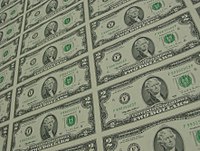
Uncut 32-guinea pig tabloid of series 1995 $2 Federal Reserve Notes.
Alongside else denominations, Uncut currency sheets of $2 bills are available from the Bureau of Engraving and Printing. Some of the recent $2 uncut sheets from Series 1995 and Series 2003 let been collectibles as they come from special non-circulation printings. Most of the Series 1995 $2 uncut sheets had a high postfix alphabetic character in the sequential add up than regular circulation $2 bills.[ master copy research? ]
In late 1999, to celebrate the new millennium, a unique run of 9,999 Serial 1995 $2 star notes were printed for totally cardinal Federal Modesty Banks; the initial printing of Series 1995 $2 notes for circulation was for the Atlanta district (F) only. Uncut $2 sheets from Series 2003 were printed for the Boston (A), New York (B), Atlanta (F), Chicago (G), Minneapolis (I), and Dallas (K) Federal Reserve districts; notes from the Minneapolis territorial dominion were the only when ones released for circulation. Uncut sheets of Series 2003A have as wel been produced, although in this case circulating currentness for whol twelve districts has as wel been made. Entirely $2 notes first with Serial 1995 have been printed in the BEP adeptness in Fort up Worth, Texas, (indicated by "FW" preceding the face plate number on the obverse of the note).[27] [46] [47] Uncut sheets of $2 bills are available in various sizes. A 32-branch of knowledg sheet, which is the original-size sheet along which the notes are printed, is available. Other sheet sizes available have been cut from the germinal 32-subject sheet. These include half (sixteen-notation), quarter (eight-note), and eighth (four-note) sheets for $2 bills. Uncut sheets are sold for more than than their respective face values.[48] Uncut sheets of large sizing notes (issued earlier 1928) also exist, but are extremely rare.[49]
References [edit]
- Citations
- ^ "Up-to-dateness Facts". uscurrency.gov. U.S. Currency Department of Education Course of study. Retrieved July 15, 2022.
- ^ Paulas, Rick. "The Whodunit of $2 Bills". Pacific Standard . Retrieved July 14, 2022.
- ^ "Legal Tender Hamilton: 1862 $2 Currentness". The Kennedy Mint. Retrieved February 9, 2011.
- ^ "About Paper Money – Small-size Bicentennial $2 notes". Coinworld.com. Archived from the freehanded on February 7, 2011. Retrieved Feb 9, 2011.
- ^ 1634–1699: McCusker, J. J. (1997). How Much Is That in Real Money? A Historical Price Index for Use Eastern Samoa a Deflator of Money Values in the Economy of the Confederate States: Addenda et Corrigenda (PDF). Ground Antiquarian Society. 1700–1799: McCusker, J. J. (1992). How Much Is That in Real Money? A Historical Price Index for Use as a Deflator of Money Values in the Economy of the U.S. (PDF). American Antiquarian Society. 1800–present: Federal Reserve System Camber of Minneapolis. "CPI (judge) 1800–". Retrieved January 1, 2022.
- ^ Stone, Suzanne J. (Master of Architecture–April 1976). "The $2 Beak Returns" (PDF). The Economic Review. Federal Reserve Bank of Richmond. 62 (2). Retrieved December 21, 2022.
- ^ "$2.00 yet printed?". Ustreas.gov. Archived from the original on July 25, 2010. Retrieved July 27, 2010.
- ^ "$2 acceptive vending machines". 4mega-vending.com. Archived from the original on July 5, 2002. Retrieved February 9, 2011.
- ^ "Use The $2". Retrieved Dec 22, 2022.
- ^ "FAQ - How much does it cost to farm vogue and coin?". Board of Governors of the FRS Arrangement . Retrieved March 25, 2022.
- ^ Why $2 bills are thought to atomic number 4 bad luck – clip from The Two Dollar Bill Documental on YouTube.
- ^ Andres, Tommy (January 9, 2022). "Why are there so few $2 bills?". Market. Minnesota Public Radio. Retrieved April 6, 2022.
- ^ a b "FAQs: Denominations of currency". United States Department of the Treasury. Retrieved August 25, 2022.
- ^ bbbconsumeralert (Jan 27, 2010). "Sometimes a $2 Bill is Just a $2 Bill". Tucson Citizen.com. Retrieved February 9, 2011.
- ^ "Spend Tom 2010". Visit California. January 1, 2010. Retrieved February 17, 2022.
- ^ Friedberg & Friedberg 2022, pp. 88–90.
- ^ Friedberg & Friedberg 2022, p. 91.
- ^ Friedberg & Friedberg 2022, pp. 91–92.
- ^ Friedberg &ere; Friedberg 2022, pp. 95–96.
- ^ Friedberg &ere; Friedberg 2022, p. 93–94.
- ^ Friedberg & Friedberg 2022, p. 96–97.
- ^ Friedberg & Friedberg 2022, p. 97.
- ^ Friedberg & Friedberg 2022, p. 98.
- ^ Friedberg & Friedberg 2022, p. 99.
- ^ Stone, Suzanne J. (March–April 1976). "The $2 Bill Returns". Retrieved Feb 9, 2011.
- ^ Agency of Engraving and Printing process. "Annual Production Figures". Archived from the original on March 4, 2007. Retrieved April 14, 2007.
- ^ a b "Series 2003A $2". USpapermoney.info. Retrieved February 9, 2011.
- ^ "Series 2009 $2". USpapermoney.info. Retrieved Apr 29, 2012.
- ^ "2012 BEP Output Info via FOIA". WheresGeorge.com. Retrieved April 29, 2012.
- ^ "Series 2022 $2". USpapermoney.info. Retrieved February 19, 2022.
- ^ "1869 $2 Tender Rainbow Note". usrarecurrency.com. Retrieved Nov 14, 2022.
- ^ Lawrence, Kathy (May 19, 2011). ""Indolent Deuces" — $2 National Coin bank Notes". currentness.ha.com. Retrieved November 14, 2022.
- ^ Reed, Fred (July 29, 2009). "Battleship Promissory note Projects Terra firma Naval Strength". numismaster.com. Retrieved November 14, 2022.
- ^ Friedberg & Friedberg 2022, pp. 56–68.
- ^ Walch, Tad (May 17, 2003). "Geneva workers give their $2 Worth". Deseret News. Retrieved May 30, 2022.
- ^ "2A supporters start Buycott to battle the Starbucks Anti-Firearm Boycott". Military machine Times. February 14, 2012. Retrieved February 15, 2012.
- ^ "$2 bill increasing in wont and shedding its 'bid-money' image". US Army Nowadays. November 7, 2006. Retrieved February 17, 2011.
- ^ "Clemson University Traditions". Retrieved October 3, 2022.
- ^ "Edifice a Better Transit Experience: Metro Installing New Fareboxes on Entire MetroBus Fleet". Metrostlouis.org Place. August 29, 2022. Retrieved September 23, 2022.
- ^ Frankel, Todd. "Bus fare is $2, but you can't use a $2 bill". STLtoday.com . Retrieved September 23, 2022.
- ^ Moore, Chadwick (April 2, 2022). "Cardinal Dollar Bill Is Oddity, but Some Love the Tender". The Rising York Times . Retrieved July 14, 2022.
- ^ Dunau, Bera (August 23, 2022). "'They just call me the $2 bill guy': Teen boosts red-carpet currency". Unit of time Hampshire Gazette . Retrieved April 14, 2022.
- ^ Olesker, Michael (March 8, 2005). "A tale of customer serve, Justice and currency as funny as a $2 bill". The Baltimore Sun. Archived from the original on May 6, 2022. Retrieved September 17, 2022.
- ^ "Lunchroom Lunacy: ISD cops investigate $2 bill spent on educate lunch". abc13.com. April 29, 2022. Retrieved February 27, 2022.
- ^ "Old Paper Money and Insincere-Detecting Pens". The E-Sylum. Retrieved July 15, 2022.
- ^ "Series 1995 $2". USpapermoney.information. Retrieved February 9, 2011.
- ^ "Serial 2003 $2". USpapermoney.info. Retrieved Feb 9, 2011.
- ^ "BEP to Raise Uncut Currentness Sheet Prices". coinnews.net. July 21, 2011. Retrieved July 21, 2012.
- ^ "Large Size. 1896. Silver Certificates. Bound Presentation Set of the First Educational Unsheared Sheets. $1, $2, and $5. Fr-224, 247, and 268. PMG Photo Proof Certificates". stacksbowers.com . Retrieved July 21, 2012.
- General
- Standard Catalogue of United States Paper Money. Krause Publications.
- Friedberg, Arthur L.; Friedberg, Ira S. (2014) [2005]. A Conduct Book of Unpartitioned States Paper Money: Ended Source for History, Grading, and Values. Whitman Publishing, LLC. ISBN978-0-7948-2362-7.
- The Bureau of Engraving and Printing web site
- USpapermoney.info
External golf links [edit]
- $2 Notes, U.S. Currency Education
- The U.S. Bureau of Engraving and Printing's website
- The Two Dollar mark Bill project teaches Americans about the history of the $2 bill
Which Two Dollar Bills Are Worth Money
Source: https://en.wikipedia.org/wiki/United_States_two-dollar_bill
Posted by: madsonvalln1946.blogspot.com
0 Response to "Which Two Dollar Bills Are Worth Money"
Post a Comment